令和 6 - Adopt a d:matcha Tea Tree 2026
Our Adopt-a-tea-tree program is now in its sixth year, and its mission is simple: to keep d:matcha's farms green and organic. When you adopt a tree, you provide the resources we need to plant more tea and farm without chemicals or pesticides.
As a thank you for your support, we hand-write your name on an Ema and hang it at the shrine neighboring our fields, connecting you personally to this land. Along with this tradition, you’ll receive six bags of d:matcha's organic sencha to enjoy the results of your support.
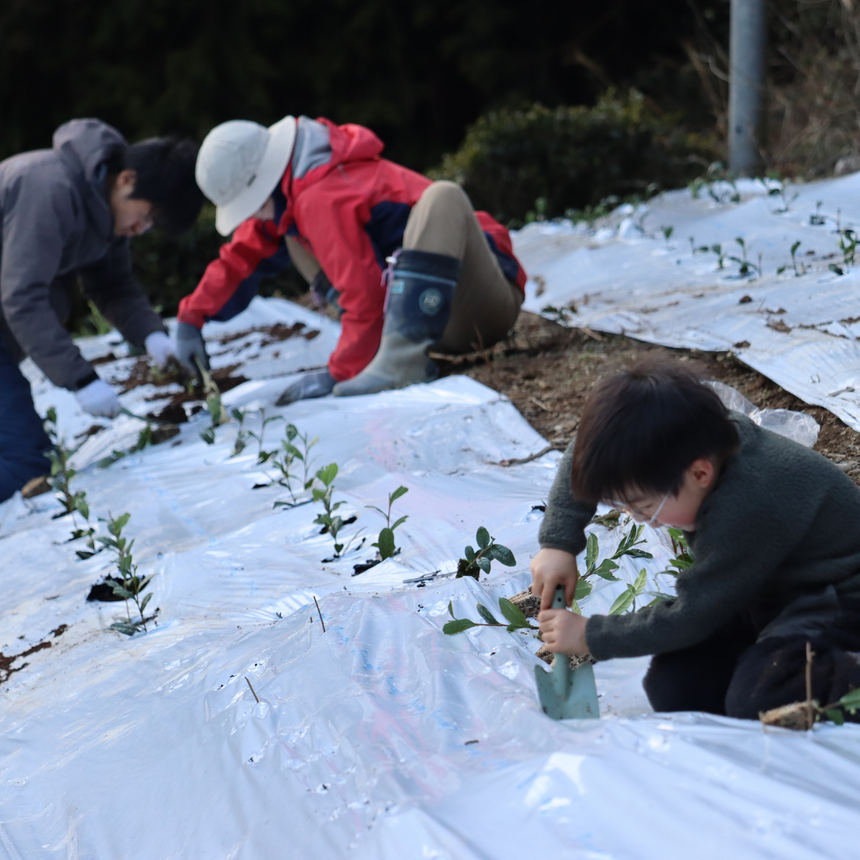
 We planted 4,500 new seedlings of Ujihikari 宇治光 on March 13th, 2026.
In addition to adopting (in name) one of d:matcha's organically grown tea trees from Wazuka Town, each of our supporter receives:
1. 6 bags of d:matcha's organic sencha (2 each) :
- Sencha Yabukita (year 2024 & 2025)
- Sencha Okumidori (year 2024 & 2025)
- Sencha Gokou (year 2024 & 2025)
- We may adjust the tea we ship based on availability.
Each of these tea fields, which are located at Hakusan shrine in Yubune, are managed organically and without the use of any pesticide. The natural characteristics of the tea fields enable us to prepare Japanese tea of the highest quality for you.
2. A handmade and handpainted 絵馬 (ema or wooden plaque) in their name. The ema will be hung at Hakusan Shrine, which is located next to our tea fields. You will also get to see your ema in person if you visit us down in Wazuka, Kyoto.
6 bags of organic sencha: Yabukita, Okumidori and Gokou (Year 2024 & 2025)
Hunging up our Handmade Ema (YouTube)
---------------------------------------------------------
What is 絵馬 Ema?
Ema are common to Japan, in which Shinto and Buddhist worshippers write prayers or wishes. The direct translation for "絵馬" is a "painted horse".
Originally, horses were considered as sacred vehicle of the god for a long time, and the aristocrats were contributing horses as a gift when they make a wish. However, most of the people cannot contribute a horse like aristocrats of course. Therefore, from Nara era (701~794), the custom contribute a wooden boards with picture of horse spread among the people in Japan. We write our wish on a wooden plaques, which is Ema, and contribute it. Nowadays we can find various designed Ema with cute animals or symbols not only a horse.
---------------------------------------------------------
- Each variation weighs 40g , and is packed in a resealable bag.
- Each serving can be brewed up to three times using different water temperatures.
- Stay up to date with the progress of the tea trees on our Instagram.