
Processing Tencha

From Leaf to Matcha: The Tencha Factory
Tencha is the crude ingredient used to make matcha. The transformation from the harvested leaf all the way down to the matcha powder is a meticulous multi-step process. Click on a step below to learn more:

Steaming
Steaming is the most critical process in Japanese tea processing, as it locks in nutrients, color, and flavor. Fresh leaves are steamed on the same day as harvest to halt oxidative fermentation. Steaming timing and temperatures are delicate variables: insufficient steaming leads to rapid deterioration, while over-steaming kills the vibrant aroma. This step requires immense technical expertise adjusted based on the daily leaf characteristics.

Cooling & Agitation
After steaming, leaves are agitated in vertical columns to drain additional moisture and separate the leaves. They are properly cooled, spread, and loosened to ensure that heat passes evenly during the drying stage.
Drying: The Furnace
This stage produces "Crude Tencha." Tea leaves travel on 3 conveyor belts through a tencha drying oven, called tencha-ro (碾茶炉). Farmers in Uji traditionally use the Horii-style furnace, although new drying furnaces have been created to improve efficiency.

Brick Furnace (Horii-Style)
Developed around 100 years ago by Mr. Horii in Uji and uses brick furnaces to dry leaves. The furnace is heated to 200°C and uses far-infrared radiation for slow, uniform drying that preserves umami and aroma. Leaves are dried for 30min. This furnace generally processes 80–100 kg of fresh leaves per hour.

Net-Type Furnace
Uses stainless steel mesh to generate high-temperature hot air and radiant heat, replicating brick furnace conditions. Highly efficient (up to 400kg/hr) and increasingly adopted in large-scale production areas, particularly in Kagoshima.

Secondary Refining
Crude Tencha is refined to remove stems and veins. If this step is insufficient, the final powder will contain white fibrous material and may clog stone mills. High-precision sorting is therefore essential for producing high-quality matcha. Re-drying may also be performed according to consumer preferences to enhance aroma.
Milling into Matcha
Finally, Tencha is ground into Matcha powder. The method of grinding determines the microscopic shape of the particles, which directly impacts the flavor perception, froth, and quality of the tea.
| Stone-Mill | Ball-Mill | Bead-Mill | |
|---|---|---|---|
| Visual |  |
 |
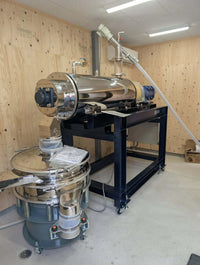 |
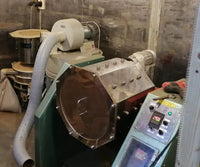
| Method | Slowly ground between two rotating granite surfaces. | Balls inside a rotating drum collide with Tencha, pulverizing it. | Small beads agitated at high speed, grinding through collision forces. |
| Speed | Very slow, 40g/h | Medium, Few kg/h | Fast, Tens of kg/h |
| Heat | Minimal | Higher, carefully controlled | Moderate, carefully controlled |
| Texture | Silky, ultra-fine | Fine and consistent | Fine, very uniform |
| Output | 5–10 microns | 15–20 microns | 10–20 microns |
| Quality | Best | Good | Better |

